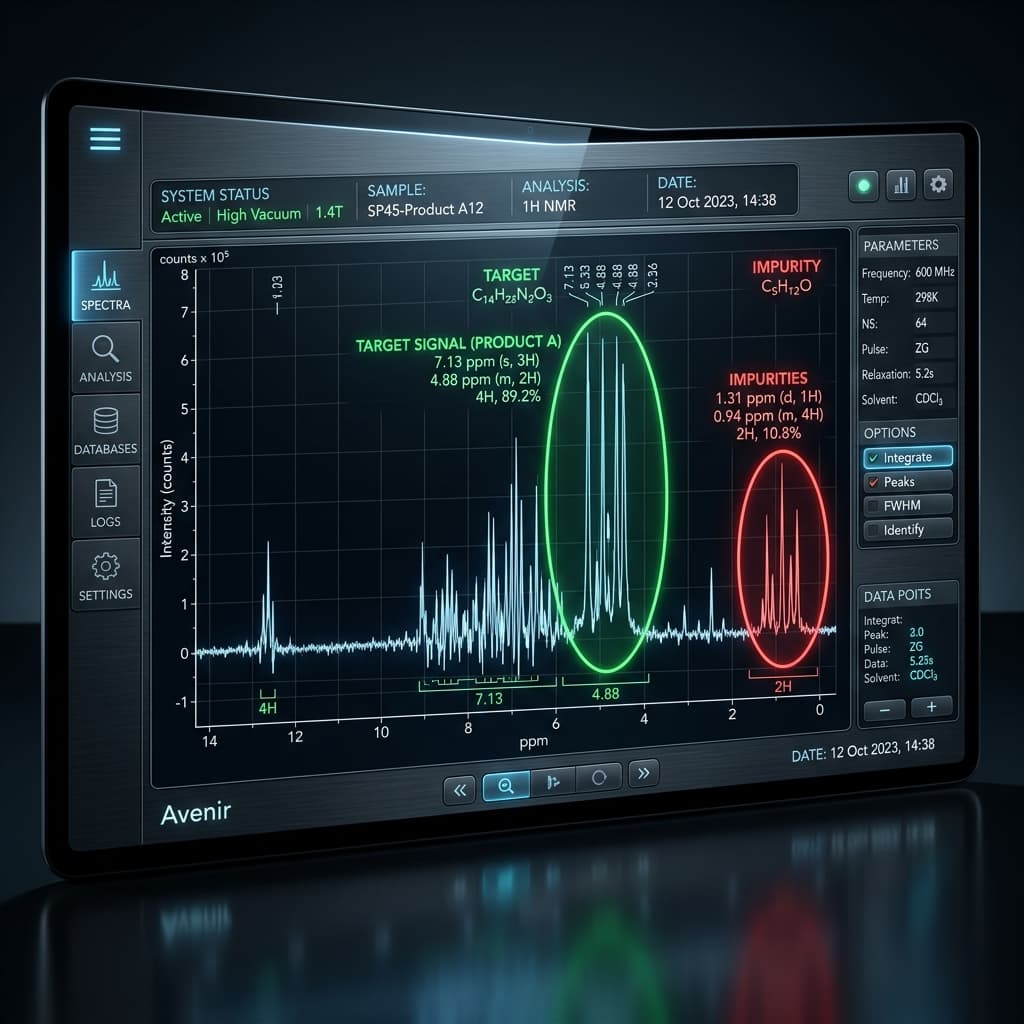
How to Tell NMR Impurity Peaks from Real Signals
The Mystery Peak Crisis: Why Interpretation is an Art
It happens to every chemist: you pull your ¹H NMR spectrum from the spectrometer, and everything looks perfect—except for that one sharp singlet at 1.56 ppm and a weird, broad "hump" at 0.07 ppm. Your product shouldn't have any aliphatic protons, so what are you looking at?
Is it a side product? Unreacted starting material? Or is it just the ghost of the hexane you used for your column or the grease from your stopcock?
At the Jaconir Team, we understand that identifying NMR impurity peaks is more than just a chore—it’s a critical part of scientific integrity. During the development of our NMR Impurity Solver, we formalized a diagnostic workflow that moves beyond guessing. This guide will teach you that professional workflow so you can confidently label your spectra for publication.
The 4-Step Diagnostic Workflow
When you encounter a peak that doesn't "fit" your structure, follow this systematic checklist.
Step 1: Check the "Usual Suspects" (Shift Match)
Before you panic, check if the peak matches a known solvent or common contaminant.
- Water: In CDCl₃, it is a broad singlet near 1.56 ppm. In DMSO-d₆, it’s near 3.33 ppm.
- Grease: Silicone grease is a sharp singlet at 0.07 ppm (often appearing even in ultra-pure samples). Hydrocarbon grease shows a broad "alkane hump" around 0.8–1.3 ppm.
- Acetone: A sharp singlet at 2.17 ppm.
If your peak is exactly on one of these numbers, you’ve likely found your culprit.
Step 2: The Integration Conflict (Stoichiometry)
Integration is the most powerful tool for impurity identification.
- The Rule: In a pure compound, all integrals must be relative to a whole number of protons (or at least consistent with a single molecular ratio).
- The Conflict: If your aromatic protons integrate to 1.0H each, but your mystery peak integrates to 0.05H, it is almost certainly an impurity.
Protons in your actual molecule must exist in whole-number ratios relative to each other. If the math doesn't add up, the peak doesn't belong.
Step 3: Multiplicity and J-Coupling Analysis
Does the splitting pattern make chemical sense?
- Example: If you suspect a peak is Ethyl Acetate, you must see three signals: a triplet (3H), a singlet (3H), and a quartet (2H). If you only see a triplet and a quartet but no singlet at ~2.05 ppm, then what you are looking at is not Ethyl Acetate.
- Coupling Constants ($J$): Measure the distance between the peaks in your multiplet ($J$ in Hz). If the $J$ value of your mystery peak doesn't match the $J$ values of the protons it is supposedly coupled to, they aren't part of the same spin system.
Step 4: The D₂O Shake (Exchangeable Test)
Is the peak an OH, NH, or SH group?
- Add a drop of Deuterium Oxide (D₂O) to your NMR tube.
- Shake well.
- Re-run the spectrum.
- Result: If the peak disappears, it was an exchangeable proton.
This is the definitive test for residual water, alcohols, or amines.
Common Contaminants and How to Spot Them
| Impurity | Likely Source | CDCl₃ Shift (ppm) | Visual Clue |
|---|---|---|---|
| H₂O (Water) | Atmospheric moisture | 1.56 | Broad baseline peak |
| Silicone Grease | Ground glass joints | 0.07 | Sharp singlet; very common |
| Hexanes | Chromatography | 0.88, 1.25 | Typical 3:4 alkyl integration |
| Ethyl Acetate | Extraction/Column | 1.26, 2.05, 4.12 | Triplet, Singlet, Quartet |
| DCM (Dichloromethane) | Solvent wash | 5.30 | Sharp singlet |
| Methanol | NMR tube cleaning | 3.49 | Sharp singlet |
| Grease (Hydrocarbon) | Vacuum pump / Lubricant | 0.8 - 1.3 | Broad, messy hump |
The "Grease Hump" vs. Product
Hydrocarbon grease is the bane of the organic chemist. Because it is a mixture of many different alkanes, it doesn't show sharp lines. Instead, it creates a broad, messy elevation of the baseline in the 0.8 to 1.3 ppm region. Pro-tip: If your baseline looks "noisy" or "dirty" only in that specific window, you likely have residual pump oil or paraffins in your sample.
Silicone Oil and Vacuum Systems
If you use a diffusion pump or a high-vacuum line, you might encounter silicone oil (polydimethylsiloxane). It is a sharp singlet at 0.00 to 0.10 ppm. It is often confused with TMS (Tetramethylsilane), which is exactly at 0.00 ppm. Difference: Silicone oil is usually slightly downfield of TMS (~0.07 ppm). Interestingly, we've seen silicone oil peaks drift slightly depending on the age of the oil and the magnetic field strength of the spectrometer.
Case Study: The "Mystery Methyl" at 2.17 ppm (Acetone Contamination)
One of the most frequent support tickets we see at Jaconir involves a sharp singlet at 2.17 ppm in CDCl₃.
- The Symptom: The user sees a peak where they expect an acetyl group (CH₃C=O), but the integration is too low (e.g., 0.15H instead of 3H).
- The Diagnosis: This is trace Acetone. It typically comes from washing NMR tubes with acetone and not drying them sufficiently in an oven or under high vacuum.
- The Fix: Before making your next sample, rinse the tube with a small amount of the deuterated solvent you intend to use. This "pre-rinse" removes the acetone residue that high heat sometimes misses.
Advanced Identification: 2D NMR and Relaxation
When 1D NMR fails, the pros turn to 2D techniques and relaxation analysis.
1. COSY (Correlation Spectroscopy)
If you have a mystery peak and you aren't sure if it's coupled to anything, run a COSY.
- Impurity Result: Most solvent impurities (like Acetone or DCM) are singlets. They will show a spot on the diagonal but no cross-peaks.
- Product Result: If the peak is part of your molecule, you will see cross-peaks connecting it to its neighboring protons. This is a definitive way to "isolate" your product spin system from the "garbage" signals of the solvent.
2. HSQC (Heteronuclear Single Quantum Coherence)
HSQC correlates protons with the carbons they are attached to.
- The Power of Carbon: Many impurities have distinctive ¹³C shifts. For example, the carbon signal for DCM is at 53.5 ppm. If your HSQC shows a correlation between a proton at 5.30 ppm and a carbon at 53.5 ppm, you have 100% proof it is Dichloromethane.
3. Line Width and T₁ Relaxation
Wait—is that broad baseline hump an impurity or just a "slow" proton?
- Small Molecules: Usually have long T₁ relaxation times and sharp peaks.
- Polymers/Grease: Large, heavy molecules (like grease) have very short T₂ relaxation times, which leads to line broadening. If you see a peak that is significantly broader than your product peaks, it is likely a high-molecular-weight contaminant like grease or pump oil.
The Problem of Solvent Carryover
In modern labs with automated sample changers and robotic liquid handlers, carryover is a real risk. If the previous user ran a 500mM sample of a steroid and you follow up with a 5mM sample of a peptide, you might see "ghost signals" from their steroid in your spectrum.
- The Jaconir Rule: If you see a complex pattern that integrates perfectly but makes zero sense for your chemistry, ask the facility manager what was run in the probe immediately before you.
Checklist for a Clean Spectrum
- Preparation: Always use PTFE-lined caps. Never use rubber septa for long-term solvent storage; plasticizers from the rubber (phthalates) will leach into your sample. You'll see these as aromatic multiplets at 7.5–7.7 ppm and a methylene quartet near 4.2 ppm.
- Glassware: Triple-rinse your NMR tubes with the deuterated solvent you will use for the experiment, not just acetone. Oven-dry them at 120°C for at least 4 hours if possible.
- Filtration: If your sample has particulates, filter it through a Pasteur pipette with a small plug of Celite or glass wool. This prevents "line broadening" caused by solid particles disrupting the magnetic field homogeneity (shimming).
- Drying: Use a high-vacuum line (Schlenk line) for at least 2 hours to remove trace ethyl acetate or hexanes. Many "oily" products trap solvent in their matrix; gentle heating (e.g., a warm water bath) while on the vacuum line can help release these trapped molecules.
Advanced Identification: Using the Solvent Effect
If a mystery peak is buried under your main product signals, use ASIS (Aromatic Solvent Induced Shift).
- Evaporate your samples.
- Dissolve the mixture in Benzene-d₆ (C₆D₆) instead of CDCl₃.
- Result: The benzene ring current will shift your impurity and product signals by different amounts. Overlapping peaks will often "unmount" and become visible as separate signals.
In C₆D₆, the water peak moves dramatically upfield to ~0.4 ppm, while in CDCl₃ it sits at 1.56 ppm. This shift is a definitive fingerprint for water.
Instant Impurity Identification
Don't waste time scrolling through PDFs. Enter your mystery ppm values into our NMR solver and get instant matches for common lab contaminants tailored to your specific deuterated solvent.
Checklist for a Clean Spectrum
- Preparation: Always use PTFE-lined caps. Never use rubber septa for long-term solvent storage; plasticizers from the rubber will leach into your sample (look for aromatic peaks at 7.5-7.7 ppm).
- Glassware: Triple-rinse your NMR tubes with the deuterated solvent you will use for the experiment, not just acetone.
- Filtration: If your sample has particulates, filter it through a Pasteur pipette with a small plug of Celite or glass wool.
- Drying: Use a high-vacuum line (Schlenk line) for at least 2 hours to remove trace ethyl acetate or hexanes.
By proactively labeling these peaks, you demonstrate mastery of your data:
"Selected ¹H NMR (CDCl₃, 400 MHz): ... δ 1.56 (s, br, H₂O impurity), 0.07 (s, silicone grease), 2.17 (s, trace acetone). Final integration adjusted for residual solvent signals."
This transparency is the hallmark of professional research.
Conclusion
Telling an impurity from a real signal is a mixture of logic, math, and experience. By applying the Jaconir Integration Rule and referencing common shift tables, you can eliminate structural ambiguity and present your research with 100% confidence.
Ready to assign your actual product peaks? Check out our Definitive 1H NMR Chemical Shift Table to master the electronic playground of functional groups!
About the Author This guide was produced by the Jaconir Analytical Research Group. We build elite digital tools for the modern chemist, including the NMR Impurity Solver and the Chemical Equation Balancer Pro. Our mission is to make high-level characterization accessible to everyone, from undergraduates to senior PIs.